I built CareerVault to help myself and colleagues generate résumés from rich career profiles, evaluate how well a role matched that experience, and tailor application materials without making up facts. I wanted the discipline of a literature review: assemble the evidence, reconcile the sources, preserve uncertainty, and make the reasoning inspectable.
Not everyone enjoys writing résumés—much less customizing them for individual roles and navigating applicant tracking systems (ATS). A short résumé also leaves out much of the work that might matter for the next application. CareerVault kept a fuller record and used each job description as a different lens over it.
Why I’m discontinuing the hosted product
The rapid advance in model capability changed my reason for maintaining CareerVault as a hosted web app. For this narrative-profile workflow, stronger models and larger context windows have made it practical to bring a rich profile and its source material into a single conversation, then work through reconciliation, role fit, and drafting together.
CareerVault wrapped earlier models in a retrieval-augmented generation (RAG) system and an evidence-focused domain layer. That was a useful engineering approach to the problem I had. Today, I would start with a capable model, an organized profile, and explicit review of uncertain inputs before deciding whether a separate retrieval system earns its complexity.
This is my judgment about this workflow, rather than a claim that retrieval is obsolete or every model judgment is reliable. The evidence and the applicant’s review still matter.
I’m happy to demonstrate the preserved system if you’re interested. I built and used it as practical software for myself and friends; I’m now keeping the work as an engineering case study rather than pursuing it as a hosted business.
The working application
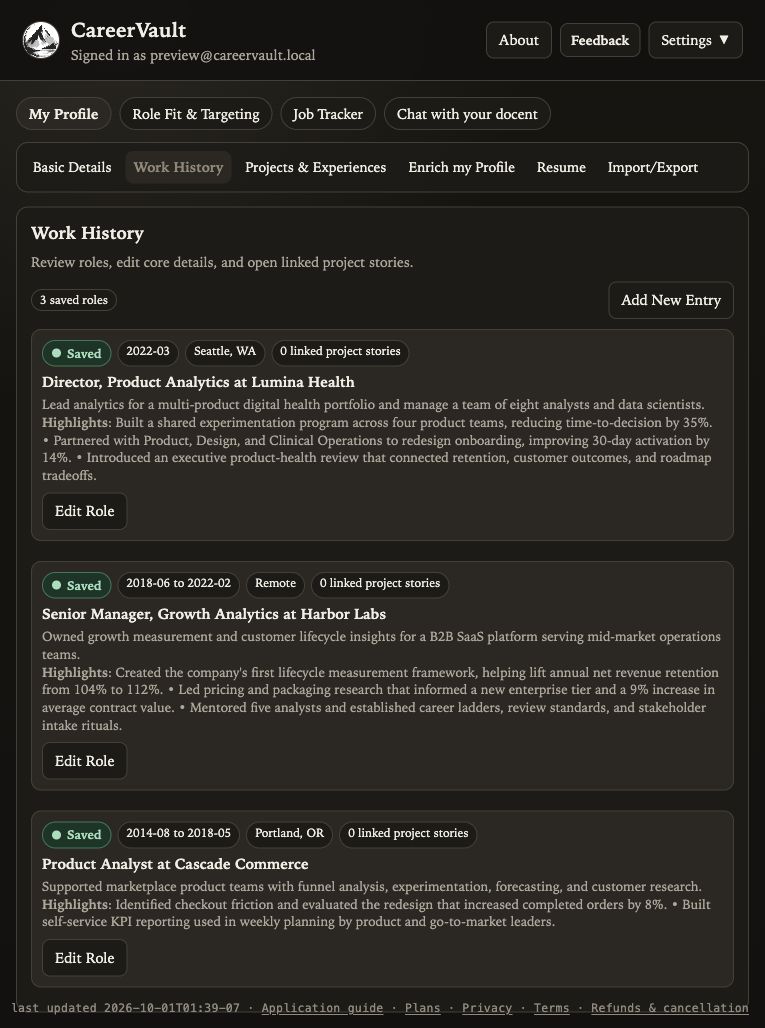
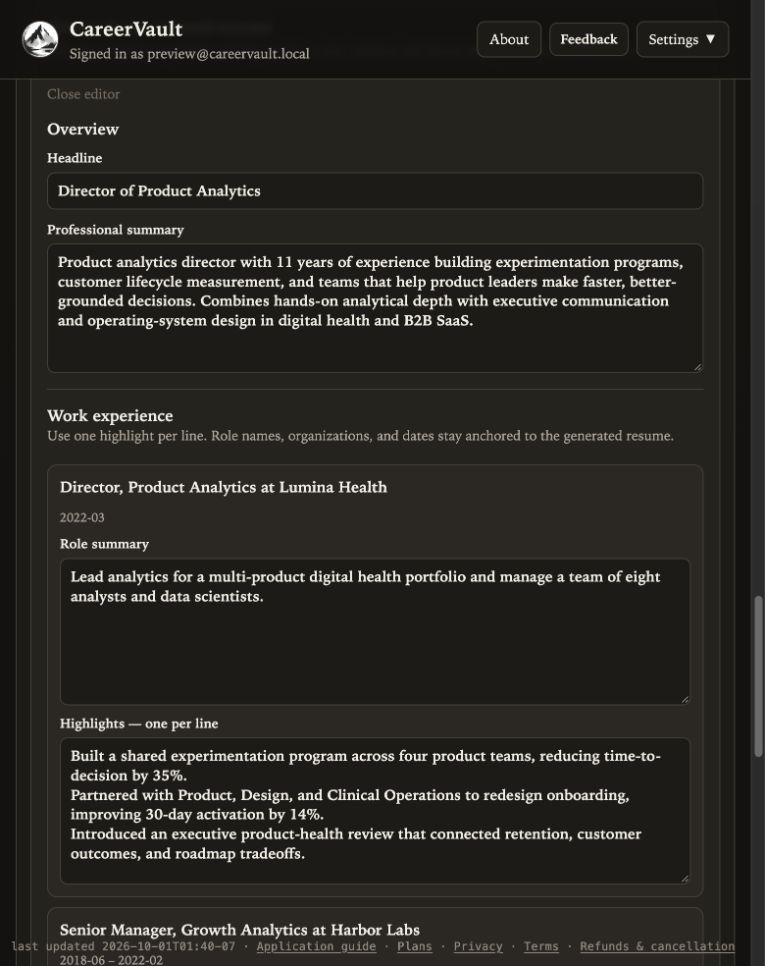
These are screenshots of the preserved web application, using a synthesized preview profile. The names, employers, role, and achievement figures are demonstration material. They are not my career history or measures of CareerVault’s impact.
Application tour
Keep the fuller career recordWork History keeps responsibilities and evidence beyond the one-page résumé. This capture shows three saved roles in the preview account.Open full screenshot ↗
Read the role against the evidenceAn existing role-fit assessment connects its readout to requirement evidence. The expanded check preserves quarterly travel as a question that is not yet established in the profile.Open full screenshot ↗
Review the proposed résuméAn existing tailored draft can be inspected and revised. No wording was changed or saved during capture, and generation and export were not retested.Open full screenshot ↗
Scroll inside each screenshot to inspect it, or open the full image. Use the arrows or numbered buttons to change slides.
The engineering behind it
The original technical overview explained why the evidence came before the output. These six frames preserve that account, from incomplete source material to the boundary between model proposals and validated claims.
Evidence before output
01 / The source problem
A résumé is an extract, not the record.
No single résumé tells the whole story. Older files preserve details we may forget; talking it through surfaces work that never made the page.
Bring old documents and newly recalled experience together.
Reconcile overlap, contradictions, and missing detail.
Keep a fuller record than any single application needs.
The technical overview described the system’s design. It did not establish hiring outcomes.
02 / The system
Preserve evidence before output.
CareerVault recovers, reconciles, and versions career evidence before generating role-specific conclusions or application materials.
Documents + conversationBring old files and newly surfaced details together.
Parse · normalize · dedupeStructure the material and flag overlap or conflict.
Versioned career recordKeep the evidence state durable and correctable.
Select for the jobUse the role as a lens over the record.
Match + résumé outputsGenerate decision support and application materials last.
Human review resolves ambiguity and keeps failures, truncation, and conflicts visible.
03 / The central guardrail
Missing evidence stays unknown.
Silence is not a negative fact. Support, missingness, and explicit contradiction need different interpretations.
Evidence states and their interpretation
Evidence
Interpretation
Verified supporting evidence
Met or partial
No authoritative evidence
Unknown
Explicit authoritative contradiction
Not met / conflict
An old résumé’s omission does not establish that the person lacks the experience.
04 / The model boundary
The model proposes; checks constrain.
The model interprets and expresses. Deterministic checks enforce selected source-reference and status invariants around its proposal.
Select the job-specific evidence packet.
Request a bounded, structured proposal.
Verify source, quote, and relation references.
Derive the status or reviewable artifact.
These checks constrain allowable claims. They do not guarantee every model judgment is correct.
05 / Evaluation
Invariants are not outcomes.
Passing a source-reference check is not the same as producing a useful résumé. Implemented checks and proposed outcome evaluation stay separate.
Implemented checks
Parser bounds
Duplicate rules
Canonical versioning
Source-reference checks
Further evaluation proposed
Unsupported-claim rate
Relevant-evidence recall
Correct abstention
Identity and timeline consistency
Blinded human usefulness
06 / Lessons learned
The evidence remains the asset.
The résumé becomes an output. The reusable engineering is in preserving facts, surfacing uncertainty, and validating generated conclusions.
Version the evidence state.
Keep unknowns visible.
Separate model expression from source authority.
Build the record once. Change the lens for each role.
Longer frames scroll vertically. Use the arrows or numbered buttons to change slides.
What I’m keeping
I designed and built the workflow, data model, interface, API, background processing, document exports, and deployment. The reusable work is in versioned evidence, reviewable model outputs, explicit unknowns, and the operational details that connect them.
For a demonstration or a conversation about the engineering, email me.
Current status
Discontinued as a hosted product. The working application is preserved privately for demonstrations and engineering review.